Sound familiar?
AI use is happening. Now you have to prove its worth.
Adoption happened. Proof didn’t.
Everyone’s productive. Nothing’s provable.
Leadership wants the number. You don’t have it.
A mandate without a method is not a strategy. It is exposure.
The solution
A system, not more tools.
Leadership asks what AI returned this quarter and you have the number, because it was agreed before the work started. Three decision gates do that, installed into the workflow your team already runs. First class on Claude, portable to any capable agent.
Gate 1 · Intent
Is this worth starting?
Every piece of work maps to a business goal and a real customer pain before it begins.
Installed by the Assess workstream
Gate 2 · Decision
What do we build, and what does good look like?
A shared, written bar set before work starts. Where design judgment lives, and the one part AI cannot do for the team.
Installed by the Enable workstream
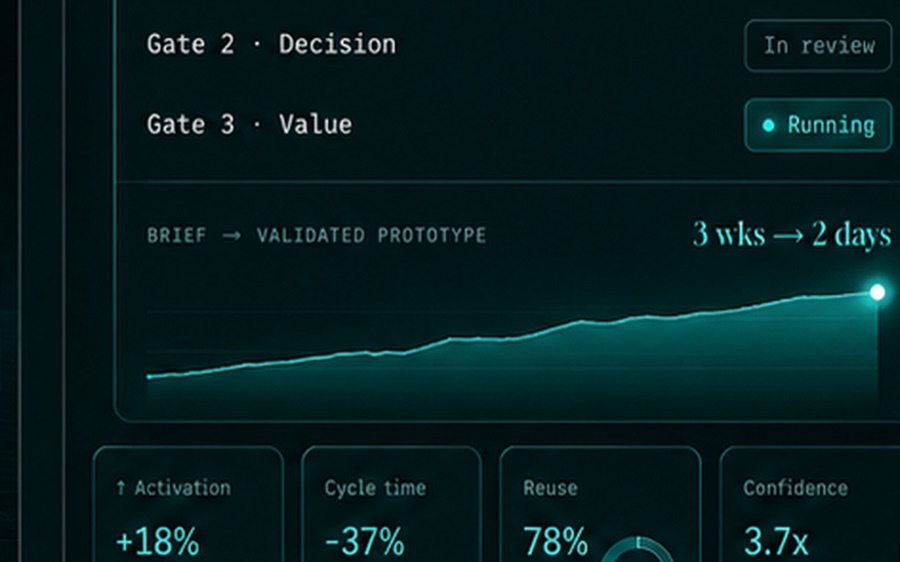
Gate 3 · Value
Did it move the needle?
Every accelerated ship gets checked against the business number agreed before work started. The proof loop.
Installed by the Prove workstream
first-class on Claude · portable to any capable agent
What the system proves
Anyone can claim it got faster. Almost no one can draw the line to the business.
The scorecard is part of what gets installed. Your team fills it as work ships, so the evidence is theirs to keep rather than a claim I make on their behalf.
Layer one · The speed
The work got faster and cheaper.
Brief to validated prototype compressed, more directions per brief, cost per validated learning down.
Layer two · The outcome
The speed paid off.
A real metric moved and mapped back to the business goal — from signal at prototype to performance after ship.
That line, from speed to outcome, is the product.
The engagement
Installed in stages, scoped to your team.
Every team arrives somewhere different, so every engagement is scoped on a call. What does not change is the order: direction first, then the team, then the proof.
The engagement · all three workstreams
90 days, then it is yours to run.
One engagement · transferred to your team · scoped on a call
The AI operating system installed into your workflow, transferred to your team, and proven against a real number.
What gets installed
The machine at the core
Design Team OS — three decision gates that hold the quality bar, a conductor that routes the loop, and a work ledger that carries the proof. The engine that turns speed into outcomes you can measure.
- ✓Brief to validated prototype in days, measured from Week 1
- ✓Every initiative tied to a business goal and a number
- ✓The stack you already bought finally gets used
- ✓The whole machine transfers to your team — yours to run and keep
Every engagement installs all three gates. How deep each workstream goes depends on what your team already has, which is what we scope on the call. See where your team would start →
Ongoing · after the engagement, your choice
Maintained
Your team runs it.
Ongoing · monthly
I keep the machine current underneath them as the tools change.
- —Skills updated the week the tools change
- —Monthly scorecard pulse, quarterly stack refresh
- —Async support
Operated
I run it with you.
Ongoing · monthly
I stay in the weekly cadence with your team rather than handing it over and leaving.
- +Everything in Maintained
- +I run the weekly cadence — gate reviews, scorecard readouts, prototype-to-MVP support
Custom & multi-team
Multiple teams, an embedded operator, or an ongoing arrangement? Scope, terms and pricing are set to your needs. Let’s talk it through.
The math against the alternatives
Opposite economics. The others bill for as long as you keep them. This one is scoped once, to what your team actually needs, and ends with you owning it.
The guarantee
One real project, run all the way through the system, and the outcome measured against a business number. You end with tangible proof, not a claim.
Frequently asked
Questions, answered.
01Do we need specific tools, or Claude in particular?
The full automated machine — the conductor, the work ledger, the one-command install — runs in Claude, and Claude Code is where it is most hands-off. The gates themselves are portable instructions, so we adapt and prove them on whatever your team runs: Cursor, ChatGPT, Gemini, with manual routing where the automation does not reach. You buy the seats you already want; you are never forced onto Claude to get value.
02Do you set up every designer, or do we come installed?
Either. If your team is already running its stack, I install the operating system on top of it. If you need every environment stood up and configured first, that is what the Enable workstream covers. Every engagement includes all three workstreams; how deep each one goes is what the scoping conversation establishes, after a discovery call.
03Who runs it after the 90 days?
Your team owns the system either way — that’s the point of the transfer. Phase 2 sets my role: maintained means I keep the machine current while your team operates it. Operated means I stay in the loop and run the cadence with you.
04What does the engagement ask of my team?
Real work, not homework. The gates go in through the prototypes you were already going to build: two live workshops, the weekly cadence, and your actual briefs running through the pipeline from Week 1.
05What if we don’t hit the outcome?
The guarantee covers what I control: the system installed, the baseline captured, one project through all three gates with the outcome measured. I do not guarantee your team’s throughput or your business results, because those are not mine to promise. If what I own has not happened by day 90 for reasons on my side, I keep working at no cost for up to 30 more days until it has. I do not offer a refund instead, because the point is that you end up with the system running, not with your money back and nothing installed. What I ask from you is a named project owner, two live briefs, and your designers in the room for the cadence. Nothing works without those, and I would rather say that up front than discover it in week six.
06Can you scope this for multiple teams or a whole org?
Yes. Multiple teams, an embedded operator, or an ongoing arrangement — scope, terms and pricing are set to your needs. That’s the custom track; the fastest way in is a discovery call, and we scope from there.
How it starts
Simple steps. No surprises.
Run the baseline
Find out where your team actually stands before you talk to anyone. It is free, and it will not flatter you.
A discovery call
You talk, I listen. How the work really runs, where it stalls, and what leadership keeps asking you for.
The scope
I come back with what I would actually do about it, sized to what your team already has rather than a package you have to fit into.
The engagement
The system goes into how your team already works, and a real project runs through it, covered by the guarantee above.
The discovery call is thirty minutes and it is not a pitch. I ask how the work runs today; you leave with a straight read on where your team stands. If there is a fit, scoping is a separate conversation.

Roy Vergara
The operator · Fluent by Design
Not a framework sold from the outside.
I have sat in your chair, accountable for an AI mandate with no method under it. I’m Roy Vergara, 17+ years leading design teams at Amazon, Whole Foods, Dell Technologies and Zappos. Fluent is the operating system I build and refine in the open, so you can see exactly what you’re getting before we ever talk.
Free, before any conversation
The system is open. Start using it today.
Place your team on the maturity curve, follow the weekly thinking, and open up the machine itself — read it, run it, keep it. No sign-up, no pitch. Dig in as deep as you want.

Start a conversation
Everything sold here runs on the same machine that’s free on GitHub. The engagement is simply the fast, guided way in. Questions, or just want to compare notes?